


Window Surround Set: Which Components Are Included?
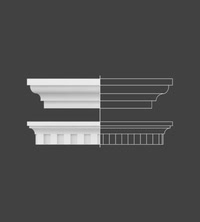
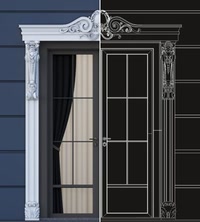
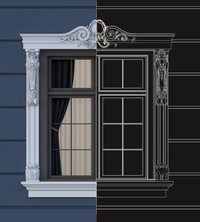
A window is finished not with a single profile, but with a coordinated set of components. What is commonly called a window surround actually refers to the complete set: two side surrounds, a top surround (lintel), a sill and an optional keystone.
As the manufacturer, we produce each component from the same mould family, ensuring that the steps in the side and top profiles meet precisely at the corners. With components sourced from different manufacturers, these profiles may not align properly, leaving visible offsets at the joints.
The cross-section range is based on live production data: 46 × 62 mm - 542 × 846 mm. Products are manufactured at 150-220 kg/m³ density, with water absorption kept at below 1%.
Window surrounds shape the exterior and interior character of a building while adding definition to architectural details. Made from Polure’s high-density polyurethane, they offer practical and durable solutions for contemporary projects, period-style buildings and restoration work that respects historic architecture. Unlike stone, marble and plaster, which are heavy, costly and labour-intensive to process, polyurethane surrounds are easier to handle and install. This category includes a wide range of products that give buildings a distinctive appearance while adding depth and visual continuity to façades. In addition to their decorative role, they can help reduce heat loss around windows by providing an insulating layer.
High-Performance Material and Manufacturing Technology
Polure Window Surrounds are made from rigid polyurethane (PU) with a density of 150-220 kg/m³. This density provides high impact resistance while making the products significantly lighter than marble, reducing the load associated with installation. Even substantial profiles such as the 137x2400x2000 mm P1456 can be carried and positioned easily by two people during installation. Our CNC-machined moulds guarantee millimetre-level precision across the range, from finely detailed models such as P1454 (40x2400x160 mm) to imposing exterior elements such as P1460 (542x2400x480 mm). The material’s closed-cell structure keeps water absorption very low, helping the products withstand rain, snow and humidity while retaining their shape for many years without cracking or swelling.
Architectural Flexibility and Design Variety
Our Window Surrounds collection meets a wide range of architectural requirements through its Surround and Surround Ornament subcategories. Stepped profiles such as P1458 and P1459 are well suited to classical and neoclassical designs, while models with clean, straight lines add a refined touch to modern residential projects. Measuring 150x2400x365 mm, P1461 can be used both for ceiling finishes indoors and as a string course on exterior façades. Specially designed surround models such as P1460M40 are ideal for architects seeking to give a building a more monumental character. All products are shipped factory-primed, allowing them to be easily painted after installation with the water-based or acrylic paint of your choice.
Cost Efficiency and Long-Term Benefits
Compared with traditional concrete or precast window surround applications, Polure solutions can reduce installation time by up to 70%. Their lightweight construction eliminates the need for heavy machinery or specialised lifting equipment, helping to lower labour costs. Thanks to their low thermal conductivity, they create an effective insulating barrier in the gaps between window frames and walls. Wide-format models such as P1457 (195x2400x260 mm) can conceal minor façade imperfections while giving windows a more pronounced architectural presence. Their resistance to UV exposure helps them withstand the effects of sunlight and keeps maintenance requirements low throughout the building’s service life.
Usage Areas
Window surrounds offer versatile applications that add value to architectural projects. On façades, they emphasise window and door frames, create visual depth and form attractive divisions between floors when used as string courses. Corner blocks can further strengthen the building’s visual lines. They are particularly effective around entrance portals in luxury villas, on boutique hotel façades and in prestigious commercial buildings where the aim is to reinforce the character and identity of the structure. Indoors, they add a prominent frame to wide door openings, niche edges and wall panelling in rooms with high ceilings. Slimmer profiles such as P1454 and P1458 can also be used as distinctive frames for mirrors or artwork. Their high resistance to humidity makes them a dependable alternative to wooden surrounds in wet areas such as bathrooms and around swimming pools.
Installation
For a secure and durable installation, first make sure that the application surface is free from dust, dirt and moisture and is completely dry. Begin by taking precise measurements of the window or door opening. For corner joints, use a mitre saw to make accurate 45-degree cuts. Apply Polifix high-grab polyurethane adhesive in continuous strips to the back of each cut surround piece. Carefully position the pieces on the wall, then use fine nails, screws or suitable supports where necessary to prevent movement while the adhesive cures. Fill the joints and any gaps between the wall and the surround with acrylic filler or a suitable specialised compound, then sand the area to achieve a smooth finish. For exterior applications, seal the upper sections with additional insulation or sealing materials to prevent water from entering behind the surround.
Care Information
Polure Window Surrounds are designed to retain their original appearance for many years with minimal maintenance. For routine cleaning, use a soft damp cloth and a mild, non-abrasive cleaner. The non-porous polyurethane surface does not readily hold dirt or dust and is resistant to bacterial growth. Under normal conditions, the products can provide a long-lasting decorative service life depending on the paint system and exposure. Minor scratches or superficial damage on exterior applications can be filled with acrylic filler and repaired with localised painting. When the building’s exterior paint is renewed, repainting the surrounds is also recommended to maintain a consistent appearance. These simple maintenance steps help extend both the decorative and functional life of the products.
Sizes and Prices
| Product code | Size (W × L × H) |
|---|---|
| P1458 | 30 × 2400 × 161 mm |
| P1454 | 40 × 2400 × 160 mm |
| P1475 | 42 × 2400 × 361 mm |
| P85402 | 46 × 2400 × 62 mm |
| P81373BU | 47 × 2400 × 163 mm |
| P14D20 | 49 × 2400 × 127 mm |
| P85401 | 49 × 2400 × 70 mm |
| PM10 | 50 × 85 × 100 mm |
| P14D25 | 60 × 2400 × 160 mm |
| P14D30 | 72 × 2400 × 194 mm |
| P9003B | 81 × 176 × 228 mm |
| P14D40 | 90 × 2400 × 255 mm |
| P1464 | 97 × 2400 × 200 mm |
| PM40 | 102 × 1200 × 366 mm |
| P1470 | 108 × 2400 × 150 mm |
| P14D50 | 110 × 2400 × 320 mm |
| P1465 | 133 × 2400 × 300 mm |
| P1456 | 137 × 2400 × 2000 mm |
| P1456D | 137 × 2400 × 2000 mm |
| P14D60 | 140 × 2400 × 385 mm |
| P1461 | 150 × 2400 × 365 mm |
| P1474 | 166 × 2400 × 227 mm |
| P9003A | 170 × 250 × 321 mm |
| P1477 | 177 × 2400 × 715 mm |
| P1462 | 184 × 2400 × 437 mm |
| P1472 | 193 × 2400 × 302 mm |
| P1457 | 195 × 2400 × 260 mm |
| P1459 | 195 × 2400 × 195 mm |
| P9001 | 211 × 227 × 271 mm |
| P9003 | 221 × 250 × 321 mm |
| P1473 | 240 × 2400 × 540 mm |
| P1462A | 260 × 2400 × 567 mm |
| P8021A | 267 × 652 × 493 mm |
| P1460 | 542 × 2400 × 480 mm |
| P1460M10 | 542 × 2400 × 480 mm |
| P1460M40 | 542 × 2400 × 846 mm |


