


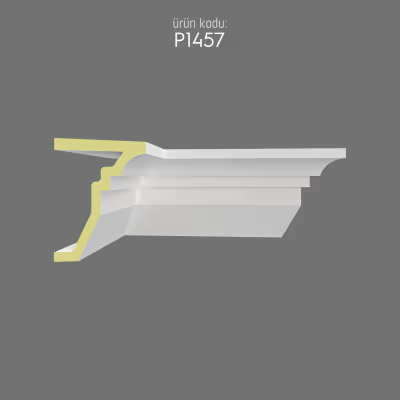
Technical Specifications
| Material | Polyurethane |
|---|---|
| Surface | Smooth, flat and stepped lines |
| Color | White |
| Density | 150-220 kg/m³ |
| Water Absorption | below 1% |
| Dimensional Stability Test | -20 °C / +70 °C |
| Fire Class | B2 (DIN 4102-1) |
| Paintable | Yes |
| Usage | Indoor + Outdoor |
| Water Resistant | Yes |
| Dimensions | 195 × 2400 × 260 mm |
| Weight | 6.30 kg |
| Sales Unit | piece |
Details
Support
Technical drawing: Download DWG (40 KB)
Similar Products(Window Surrounds)


Our P1457 profile is a high-durability architectural molding designed to elegantly frame window and door surrounds on building facades or to create horizontal lines between floors. It adds visual depth to both modern and neoclassical architectural projects while enhancing the overall character of the exterior.
Manufactured from high-density rigid polyurethane, this profile features a density of 150-220 kg/m³, offering wood-like hardness with a reduced risk of rotting. With dimensions of 195 mm depth, 260 mm height, and 2400 mm length, it creates a striking, voluminous presence on any facade. Thanks to its closed-cell structure, its water absorption rate is below 1%, and dimensional stability has been tested within -20 °C / +70 °C without shrinking or expanding.
The design features smooth flat surfaces, stepped transitions, and a wide curved profile that maximizes the play of light and shadow. Delivered with a factory-applied white primer, the product can be easily painted in any color to match your exterior design.
With its wide profile, it is highly favored as a window casing or mid-floor molding on villa facades. It can also be seamlessly integrated into interior designs, serving as a grand crown molding at wall-to-ceiling junctions or as majestic door architraves in hotel lobbies, restaurants, and spacious high-ceilinged halls.
Compared to plaster alternatives, it is exceptionally lightweight and highly resistant to shattering. Unlike EPS foam products, it does not dent easily and offers high impact resistance. During installation, Polure Polfix adhesive should be applied to the cleaned surface, followed by mechanical fastening with screws. Once joints are filled and sanded, the profile is ready for painting.
With its long-lasting structure, moisture resistance, and easy workability, it saves labor costs during installation while delivering a prestigious, enduring look that retains its original form for years to come.
- The P1457 large-scale molding profile offers a wide range of applications for both interior and exterior spaces
- On exteriors, it is primarily used as decorative window and door casings (architraves) in villas, private residences, and boutique hotel projects
- Its generous width also makes it ideal for mid-floor moldings that create elegant horizontal divisions
- Indoors, it can be utilized as a grand crown molding or a hidden LED lighting cove at ceiling-to-wall junctions in spacious areas like high-ceilinged living rooms, hotel lobbies, restaurants, and conference halls
- Additionally, it can be applied as a thick door frame molding to add depth to wide doorways and corridors
- For exterior installations, applying a UV-resistant topcoat paint is mandatory
- The installation surface must be dry, clean, and completely free of dust and grease
- The profile should be cut to fit corners using a 45-degree miter saw
- Only Polure Polfix adhesive must be used for bonding; silicone-based adhesives are not recommended
- After applying the adhesive, mechanical fastening with stainless steel screws is mandatory to ensure the product securely adheres to the facade
- Screw holes and joints are then filled with a high-quality exterior filler
- Once the filler dries, it should be sanded smooth using 180-220 grit sandpaper
- Although the factory-applied primer prepares the surface, an additional primer coat may be applied optionally to comply with paint manufacturers' warranty terms
- In the final step, apply at least two coats of water-based or synthetic paint
- A UV-resistant paint is mandatory for outdoor applications
- Assess water and moisture exposure using the product technical data, surface finish and installation details
- It can be wiped with a damp cloth or washed on exterior facades using low-pressure water
- Abrasive acids or harsh chemical solvents must not be used during cleaning
- For exterior applications, it is recommended to inspect the surface once a year and perform local paint touch-ups if necessary to extend the lifespan of the paint
- Any minor cracks or scratches resulting from physical impacts can easily be repaired using exterior filler and sandpaper before repainting
Will the P1457 casing profile be affected by rain and sun on the exterior?
No, the product is made of high-density rigid polyurethane and features a closed-cell structure. With a water absorption rate below 1%, it is highly resistant to rain, snow, and moisture, preventing rotting or swelling. It retains its shape, with dimensional stability tested between -20 °C and +70 °C. However, to prevent yellowing from UV rays, it must be painted with a UV-resistant topcoat for exterior use.
Which adhesive should I use for installation, and are screws mandatory?
Only Polure Polfix adhesive should be used for installation; silicone adhesives are not recommended. Due to the large dimensions of the profile and for safety reasons, mechanical fastening with screws is mandatory in addition to the adhesive. Screw heads and joints are then filled with putty and sanded smooth.
Does the product come pre-painted from the factory, and can I paint it directly?
The product is shipped with a factory-applied white protective primer. This primer facilitates paint adhesion. However, since paint manufacturers do not guarantee paint jobs done without their own primers, applying an additional primer coat is optional and at the customer's discretion. It can be painted with water-based or synthetic paints.
What are the advantages of polyurethane casings compared to plaster or EPS foam materials?
Include the product weight and fixing loads when assessing the substrate and supporting structure. Compared to EPS foam, it is much harder, impact-resistant, and offers sharp, clear details. Additionally, unlike wood, it is resistant to rot from moisture, ensuring a long lifespan.
Can it be used as a crown molding on ceiling corners in interior spaces?
Yes, this large 195x260 mm profile can be used as an elegant and deep crown molding (cornice) in high-ceilinged living rooms, hotel lobbies, or restaurants. Thanks to its spacious rear design, it can also be used for indirect lighting by installing LED strips behind it.