


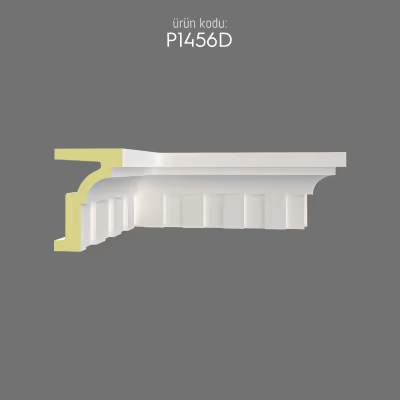
Polyurethane Window Trim and Floor Belt Course Moldings
Technical Specifications
| Material | Polyurethane |
|---|---|
| Surface | Classic-profiled, smooth surface |
| Color | White |
| Density | 150-220 kg/m³ |
| Water Absorption | below 1% |
| Dimensional Stability Test | -20 °C / +70 °C |
| Fire Class | B2 (DIN 4102-1) |
| Paintable | Yes |
| Usage | Indoor + Outdoor |
| Water Resistant | Yes |
| Dimensions | 137 × 2400 × 2000 mm |
| Weight | 3.78 kg |
| Sales Unit | piece |
Details
Support
Technical drawing: Download DWG (107 KB)
Similar Products(Window Surrounds)


Our P1456D model is a premium architectural profile designed to bring aesthetic harmony to window, door, and wall transitions in both exterior facades and grand interiors. Combining the timeless dignity of classical architecture with modern manufacturing technology, this product adds depth and a strong character to any building's facade. Unlike heavy stone or concrete alternatives, it allows you to showcase magnificent architectural details without adding extra static loads that could compromise structural safety.
Featuring a profile height of 137 mm and a length of 2400 mm, this product has ideal proportions to create a distinct line on wide facades or a balanced frame around medium-sized windows. Manufactured from high-density rigid polyurethane, the profile offers a surface hardness similar to wood with its 150-220 kg/m³ density, yet remains incredibly lightweight. Thanks to its closed-cell structure, its water absorption rate is below one percent, preventing issues like freezing, rotting, warping, or insect infestation, and ensuring superior dimensional stability against harsh weather conditions.
Looking at its visual design, the P1456D model stands out with its symmetrical dentil moldings along the bottom. This classical motif sequence, combined with the flat stepped projection at the top and a soft concave curve in the middle, creates sharp shadow plays under sunlight. Molded with smooth and crisp lines, these details ensure a seamless, clean transition on the facade, lending a prestigious historical charm to the structure.
This highly versatile profile is frequently preferred for window casings on private villas, horizontal floor belt courses, hotel lobbies, and classical restaurant projects. In interior design, it can be utilized as a grand ceiling cornice in high-ceilinged living rooms or as an elegant overdoor pediment. Thanks to its moisture- and water-resistant structure, it can be safely installed even in humid areas like bathrooms and poolside spaces.
Easy to cut and shape, the profile should be installed by applying Polure Polfix adhesive to a clean surface, followed by mechanical fastening with screws during the drying process. Joints and screw heads are then filled with exterior-grade putty and sanded to prepare for painting. While the factory-applied primer prepares the surface, using the paint manufacturer's own primer is recommended for warranty purposes; this additional primer choice is entirely up to the customer. For long-lasting exterior durability, applying two coats of UV-resistant paint after installation is mandatory.
- The P1456D dentil window trim profile offers a wide range of applications for both interior and exterior designs
- On exteriors, it is used as a window or door header (pediment) or side casing to add depth to openings
- It can also be applied as a horizontal floor belt course to elegantly divide large building facades
- For interior decoration, it serves as a grand ceiling cornice in spacious, high-ceilinged living rooms, hotel lobbies, or restaurants
- Additionally, it can be positioned as a decorative overdoor pediment to create a classic portal effect
- The installation surface must be clean, dry, and free of dust or grease
- The profile is precisely cut at 45-degree angles at the corners using a miter saw
- Apply only Polure Polfix adhesive to the mounting surface and place the profile on the wall; silicone-based adhesives must never be used
- To prevent slipping while the adhesive cures, the profiles must be mechanically secured to the wall with screws
- Joint lines and screw heads are filled with acrylic putty and smoothed using 180-220 grit sandpaper
- After applying an optional extra primer coat, complete the process with at least two coats of UV-resistant paint for exteriors, or water-based/synthetic paint for interiors
- Maintaining our polyurethane profiles is virtually effortless
- For interiors, they can be cleaned using a duster or a slightly damp cloth
- For exterior applications, they can be easily washed with low-pressure water to remove mud and dust
- Avoid using abrasive acids, thinners, or harsh chemical cleaners on the surface
- To extend the lifespan of the exterior paint and maintain UV protection, it is recommended to inspect the painted surface every few years and apply a light touch-up or fresh coat of paint if necessary
Will this window trim model be damaged by rain or sun on the exterior?
No, thanks to its closed-cell polyurethane structure, the water absorption rate is below 1%, meaning it will not rot or swell from rain, snow, or moisture. However, unpainted polyurethane can yellow over time under direct sunlight (UV). Therefore, for exterior installations, it is mandatory to paint it with a high-quality, UV-resistant exterior paint.
Is it sufficient to use only adhesive during installation?
Using only adhesive is not sufficient for installation. After applying Polure Polfix adhesive to the back of the profile, mechanical fastening with screws is mandatory to prevent slipping and ensure safety until the adhesive is completely cured.
Can the product be painted before installation, or should it be painted after?
For the cleanest and most seamless result, we recommend painting the product after it is mounted on the wall and once the joints and screw holes are puttied and sanded. This completely eliminates any color or level differences at the joints.
What advantages does it offer compared to plaster or concrete window trims?
Polyurethane window trims are extremely lightweight compared to concrete alternatives and do not add extra static load to the building. Unlike fragile plaster, they do not break or crack during transport and installation. They are far more resistant to moisture, water, and insects than wood, maintaining their smooth, detailed quality for years.
Is it mandatory to apply an extra coat of primer on the product?
Our products are shipped from the factory with a primer coating ready for paint. However, paint manufacturers do not guarantee paint jobs done without their own primer products. Therefore, while an extra primer coat is not mandatory, it is entirely up to our customer's preference and the paint brand's recommendation.