Polyurethane Faux Wood Log Models
A polyurethane faux wood log is a hollow rigid polyurethane profile moulded from the growth rings, axe marks and splits of a solid tree trunk. It builds a convincing log appearance on ceilings and walls as a decorative cladding, without carrying any load. The look is built in two layers: the texture comes from the mould, the colour from the top coat and the patina. Water absorption is below 1%, so it also suits damp rooms and sheltered exteriors.

What is a polyurethane faux wood log?
How is the wood look produced?
| Stage | What happens | Effect on the look |
|---|---|---|
| 1. Mould | A real wood surface is 3D scanned and cut on CNC | Sharpness of growth rings, knots and axe marks |
| 2. Casting | Rigid polyurethane is cast, producing a hollow profile | Depth and shadow; a cast surface, not a print |
| 3. Primer | white 1K acrylic primer is applied | Paint adhesion; a technical base, not a colour |
| 4. Top coat and patina | Wood tone is applied, dark tone left in the grooves | Grain reads; the surface never looks flat |
Can it be told apart from real wood? Five mistakes that break the look
| Mistake | Why it breaks the look | What to do instead |
|---|---|---|
| A single flat colour, no patina | Groove and crest end up the same tone and the surface reads flat | Apply dark patina over the top coat, then wipe it off the crests |
| Identical pieces laid the same way | Pieces from one mould repeat the same texture side by side | Rotate pieces and stagger the joints |
| An open log end | The hollow section shows and the illusion stops there | Fit the matching end cap for that section |
| Gloss finish | Timber reflects matt to satin; gloss gives the material away | Choose a matt or satin top coat |
| Wrong section ratio | A log is near-square, a beam is wide and flat; mixing them misreads the scale | Near-square sections for logs, flat sections for beams |
Faux wood, fake wood, imitation timber: is there a difference?
Wood tones and patina
Log, beam and rafter: the section ratio sets the look
| Product code | Section (mm) | Length | How it reads |
|---|---|---|---|
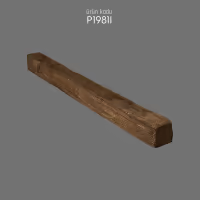
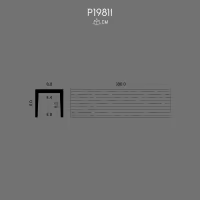
| P1981I | 80 × 80 | 3000 mm | Slim log — low ceilings, close spacing |
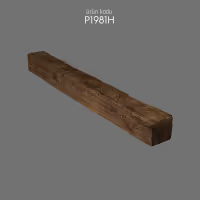
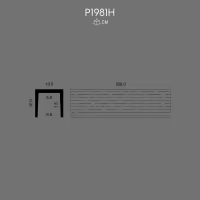
| P1981H | 100 × 100 | 3000 mm | Classic log ratio — the most used section |
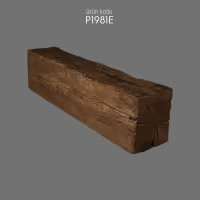
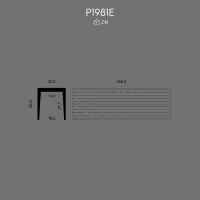
| P1981E | 200 × 250 | 3000 mm | Heavy log — high ceilings and wide spans |
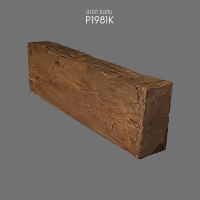
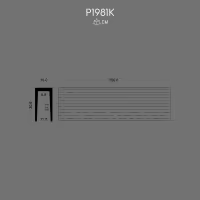
| P1981K | 150 × 306 | 3000 mm | Flat section — reads as a beam |
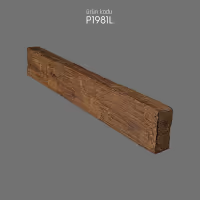
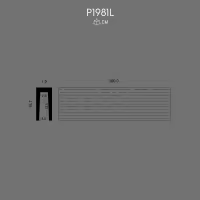
| P1981L | 75 × 157 | 3000 mm | Narrow and tall — reads as a rafter |
Which sizes are produced?
Compared with a solid timber log
| Criterion | Polyurethane faux wood log | Solid timber log |
|---|---|---|
| Weight | Hollow; one person can lift it to the ceiling | Heavy; needs a crew or a crane |
| In damp air | Water absorption below 1%; does not rot or grow mould | Takes up moisture; risk of rot and mould |
| Dimensional stability | Does not move, crack or twist | Cracks and twists as it dries |
| Insects | Not organic; no infestation | Can be infested; needs treatment |
| Maintenance | None beyond the life of the paint | Periodic varnish and upkeep |
| Fire behaviour | B2 (flame retardant) | Varies with species and treatment |
| Feel to the touch | A hard surface; not the warmth of timber | Real wood texture and scent |
| Piece to piece | Identical parts from one mould | Every piece different; natural variation |
The parts that complete the look: end caps and corbels
| Part | Product code | Size (mm) | Function |
|---|---|---|---|
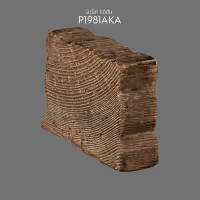
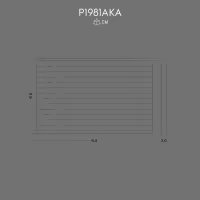
| Closing block | P1981AKA | 65 × 30 × 94 | Closes the open end on small sections |
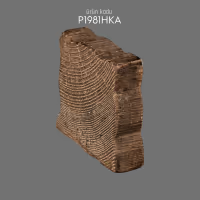
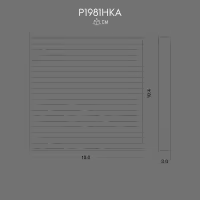
| End cap | P1981HKA | 104 × 30 × 100 | End closure on square sections |
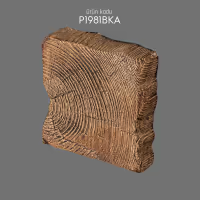
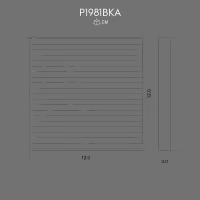
| End cap | P1981BKA | 120 × 30 × 120 | Closes the end of the 100 × 100 section |
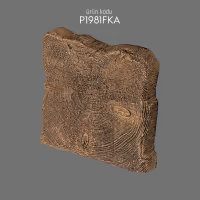
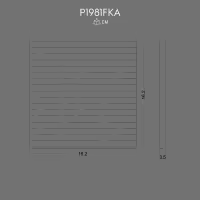
| End cap | P1981FKA | 162 × 35 × 162 | End closure on mid sections |
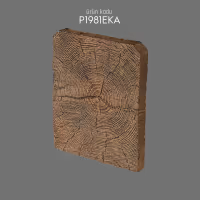
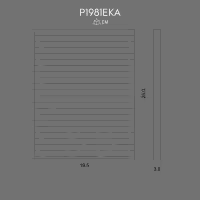
| End cap | P1981EKA | 250 × 30 × 195 | End closure on flat sections |
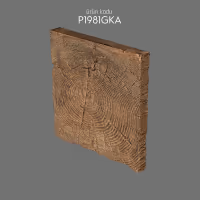
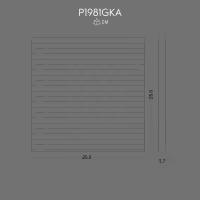
| End cap | P1981GKA | 256 × 27 × 255 | End closure on wide square sections |
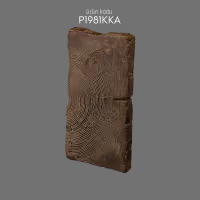
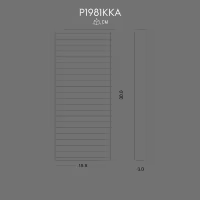
| Rustic end cap | P1981KKA | 300 × 30 × 155 | End closure on wide flat sections |
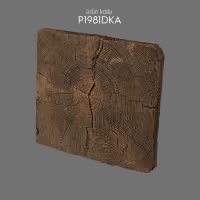
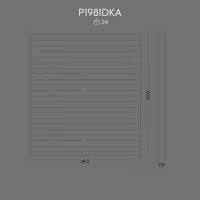
| Decorative end cap | P1981DKA | 300 × 26 × 340 | End closure on the largest section |
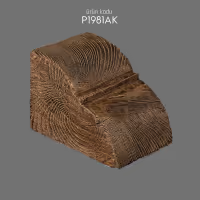
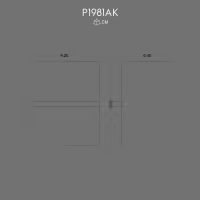
| Corbel | P1981AK | 64 × 85 × 92 | Gives a supported look at the wall junction |
Where it is used
Installation and painting in brief
Related Topics
Related Products
Related Categories
Application Gallery


Related Guides
Frequently Asked Questions
Does a polyurethane faux wood log look like real timber?
At normal viewing distance, largely yes. The texture is moulded from a 3D scan of a real timber surface, so growth rings, knots and axe marks come out sharp, and the grain reads once patina is applied. Up close and to the touch it feels like a hard surface rather than timber.
Is the wood texture painted on?
No. The texture comes from the mould and is the profile's own surface; paint only supplies the colour. That is why it cannot be worn or wiped away.
Will the pattern repeat on logs laid side by side?
Pieces from the same mould carry the same texture. Rotating the pieces and staggering the joints makes the repeat unnoticeable.
Which wood tones can be applied?
Walnut, oak and distressed tones are the most requested. The method is the same: a dark patina over a light base, wiped off the crests and left in the grooves.
Is the factory primer a finish coat?
It is not. The product ships with white 1K acrylic primer, a technical base for paint adhesion. The wood look comes from the top coat and the patina.
Is a faux wood log the same as a polyurethane log?
They are the same product. Faux wood log, fake wood log and imitation timber log all describe one profile in everyday use: a hollow rigid polyurethane section with a moulded wood texture. The genuinely separate product is the EPS log, whose soft surface behaves differently for detail and impact.
Is a faux wood log load-bearing?
No. It is a decorative cladding and carries no load. The ceiling is supported by the building's own structure.
Can it be used in damp rooms and under eaves?
Yes. Water absorption is below 1%, so it does not rot or grow mould. Surfaces in permanent contact with water, such as shower or pool interiors, are out of scope.
How does it differ from a solid timber log?
It takes up no moisture so it does not crack or twist, it is not organic so insects do not attack it, it is hollow so one person can install it, and it is classified B2 (flame retardant). In exchange, the feel to the touch and the natural variation between pieces stay with solid timber.
Which sections and lengths are available?
Near-square log sections of 80 × 80 and 100 × 100 mm, a heavy 200 × 250 mm section, a flat beam section of 150 × 306 mm and a narrow rafter section of 75 × 157 mm. Standard length is 3000 mm.
How is the open end of a log closed?
An end cap is produced in the matching size for every section; the 100 × 100 section uses P1981BKA, for example. Where the log meets a wall, a corbel is preferred.
How is it cut and installed?
Cut with a fine-toothed hand saw or a mitre saw and mitre the corners at 45°. Apply PU-based mounting adhesive as an unbroken bead, screw the piece from both sides and fill the sunk screw heads. Silicone-based adhesive is not used.
Will the wood look fade outdoors?
Fading depends on the paint, not on the material. With a UV-resistant, flexible facade paint the colour holds for a long time, and the profile stays dimensionally stable across -100 °C / +80 °C.
How is the price set?
Log profiles are priced per 3-metre piece, with end caps and corbels as separate items. The price covers the product only; goods are ex-works. Quotations are free and valid for 7 days.
Get a price quote for your project
Share your measurements and photos of the application area; we will prepare your quote including products and installation.