

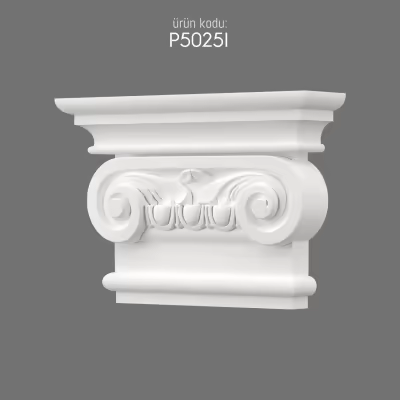
35x35x24 cm Ionian Pilaster Capital Polyurethane Decoration Product
Technical Specifications
| Material | Poliüretan bazlı dekorasyon ürünü |
|---|---|
| Surface | Dekoratif yüzey dokusu; uygulama ve boya öncesinde yüzey hazırlığı gerektirebilir. |
| Color | Boyanabilir; standart renk bilgisi belirtilmemiştir. |
| Density | Belirtilmemiştir. |
| Water Absorption | below 1% |
| Service Temperature | -100 °C / +80 °C |
| Fire Class | B2 (flame retardant) |
| Paintable | Yes |
| Usage | Indoor + Outdoor |
| Water Resistant | Yes |
| Diameter | Ø 35 cm |
| Dimensions | 353 × 353 × 242 mm |
| Sales Unit | piece |
Details
Support
Similar Products(Pilaster Column Ionic Capital)


The Ionian pilaster capital is a polyurethane-based decorative product that completes the upper section of pilaster applications and adds architectural emphasis to exterior or interior compositions. The P5025I model can be used to visually connect the column shaft and capital within a classical architectural arrangement. Its decorative surface texture can be adapted to the project's colour scheme after painting.
The P5025I pilaster capital measures 35 x 35 x 24 cm, representing its width, depth and height respectively. Its 35 cm width and depth make it suitable for applications ranging from narrow interior walls to broad facade compositions. The rigid, closed-cell polyurethane structure has a density of 150-220 kg/m³. The material retains its form between -100 °C and +80 °C, and its water absorption rate is below 1%.
The decorative texture of the pilaster capital helps define the upper section of arrangements inspired by the Ionic order. The product arrives with a factory primer that prepares the surface for painting and can be finished with water-based or synthetic paint. Although the factory primer prepares the surface, paint manufacturers may not provide a warranty for surfaces painted without using their own primer. Additional priming is therefore optional and left to the customer's discretion. Polure does not guarantee the paint systems used and accepts no responsibility for this application.
P5025I can be used above pilaster shafts in interiors such as living rooms, entrance halls, stairway areas, hotel lobbies, restaurants and offices. It can also be used at villa entrances, around doorways and in classical facade designs. For exterior applications, it must not be left unpainted and should be finished with UV-resistant paint. The product is decorative; it does not carry structural loads and is applied as a covering over an existing supporting surface.
Before installation, the surface must be clean, dry and sound. Required cuts are made with a 45° mitre. Only polyurethane (PU) mounting adhesive should be used for fixing; silicone should not be used. Mechanical fixing with screws is mandatory, taking the product's connection loads into account. Joints and screw points are filled, smoothed with 180-220 grit sandpaper, and then finished with primer and two coats of paint. During installation, the product's own weight and the connection loads must be assessed together.
Lighter and more impact-resistant than plaster, the pilaster capital has a material structure that is better suited to resisting moisture, rot and insects than wood and MDF alternatives. It provides a harder and more detailed surface than EPS foam. Its closed-cell structure contributes to thermal and sound insulation and allows the surface to be filled, sanded and refinished when necessary. P5025I can therefore be used as a complementary architectural decoration element adaptable to a range of interior and exterior facade designs.
- The P5025I Ionian pilaster capital can be used indoors and outdoors to complete the upper section of a pilaster shaft
- In living rooms, it can finish a pilaster arrangement running along a wall; in entrance halls, it can form part of a classical composition emphasising a doorway; and it can also be used at stair landings
- It is suitable for defining the upper section of decorative, column-like arrangements in hotel lobbies, restaurants and office entrances
- On villa and detached-house facades, it adds architectural cohesion to pilaster applications around doors or windows
- When used outdoors, the surface must be protected with UV-resistant paint
- Its 35 x 35 cm width and depth create a more pronounced capital effect on broad facades, while its 24 cm height provides a balanced transition to the pilaster shaft
- The surface texture can be matched to the building's overall colours with water-based or synthetic paint
- The product is not structural and is applied as a decorative covering over an existing wall, column or facade surface
- Before installation, the surface where the pilaster capital will be placed must be clean, completely dry and sound
- Required cuts are made with a 45° mitre, and the contact surfaces of the pieces to be joined are checked
- Polyurethane (PU) mounting adhesive must be used for fixing; silicone adhesive is not recommended
- Mechanical fixing with screws is mandatory in addition to the adhesive
- Suitable fixing points must be determined by taking the product's own weight and connection loads into account
- On exterior applications, joints and screw heads are filled with exterior filler; indoors, a suitable filler is used
- Once dry, the surface is smoothed with 180-220 grit sandpaper
- The factory primer prepares the surface for painting; an additional primer recommended by the paint manufacturer may be applied if desired
- As the final step, two coats of suitable water-based or synthetic paint are applied
- Clean the pilaster capital with a soft, dry cloth without applying excessive pressure to the surface
- A slightly damp cloth may be used to remove dust, but the surface should not be left wet for extended periods
- Abrasive chemicals, stiff brushes and scratching cleaning tools may damage the decorative texture and paint layer
- For exterior applications, inspect the painted surface regularly; if fading or surface damage appears on the UV-resistant paint, refinishing should be considered
- If any opening is noticed at screw or joint points, maintenance should be carried out without delay
Can the P5025I pilaster capital be used outdoors?
Yes. P5025I can be used for the upper section of pilaster applications in exterior facade decoration. Outdoors, the product must not be left unpainted and must be finished with UV-resistant paint. Joints and screw points should be filled with exterior filler. The product is not structural and is applied as a decorative covering over an existing facade, column or wall. The soundness of the application surface and the fixing method should be assessed according to the project conditions.
How is the pilaster capital installed and painted?
After the surface has been made clean, dry and sound, the required cuts are made with a 45° mitre. Polyurethane (PU) mounting adhesive is used for installation; silicone is not used. Mechanical fixing with screws is mandatory. Joints and screw points are filled and smoothed with 180-220 grit sandpaper. The factory primer prepares the surface for painting, while additional priming is optional. Finally, two coats of suitable water-based or synthetic paint are applied.
What are the material properties of the P5025I pilaster capital?
P5025I is a decorative product made from rigid, closed-cell polyurethane. Its density is 150-220 kg/m³ and its water absorption rate is below 1%. The material retains its form between -100 °C and +80 °C. Compared with plaster, polyurethane is lighter; compared with EPS foam, it is harder and offers more detailed surfaces. The product is difficult to ignite and tends to self-extinguish once the flame source is removed. However, no additional claim should be made about fire-resistance duration or project suitability without product documentation.
What advantages does a polyurethane pilaster capital offer over plaster or wood?
A polyurethane pilaster capital is lighter than plaster and more resistant to breakage. Compared with wood and MDF alternatives, it has a material structure better suited to resisting moisture, rot and insects. Since it is harder than EPS foam, it helps protect the decorative surface and edges. It can also be filled, sanded and repainted. Nevertheless, the product is decorative and must not be used to carry structural loads.
Can the P5025I pilaster capital be painted?
Yes. P5025I arrives with a factory-primed surface prepared for painting and can be finished with water-based or synthetic paint. The factory primer prepares the surface for paint, but paint manufacturers may not provide a warranty for surfaces painted without using their own primer. Additional priming is therefore optional and left to the customer's preference. Polure does not guarantee the paint systems used. For exterior applications, UV-resistant paint should be selected when choosing the colour.
Similar Products(Pilaster Column Ionic Capital)
The Ionian pilaster capital is a polyurethane-based decorative product that completes the upper section of pilaster applications and adds architectural emphasis to exterior or interior compositions. The P5025I model can be used to visually connect the column shaft and capital within a classical architectural arrangement. Its decorative surface texture can be adapted to the project's colour scheme after painting.
The P5025I pilaster capital measures 35 x 35 x 24 cm, representing its width, depth and height respectively. Its 35 cm width and depth make it suitable for applications ranging from narrow interior walls to broad facade compositions. The rigid, closed-cell polyurethane structure has a density of 150-220 kg/m³. The material retains its form between -100 °C and +80 °C, and its water absorption rate is below 1%.
The decorative texture of the pilaster capital helps define the upper section of arrangements inspired by the Ionic order. The product arrives with a factory primer that prepares the surface for painting and can be finished with water-based or synthetic paint. Although the factory primer prepares the surface, paint manufacturers may not provide a warranty for surfaces painted without using their own primer. Additional priming is therefore optional and left to the customer's discretion. Polure does not guarantee the paint systems used and accepts no responsibility for this application.
P5025I can be used above pilaster shafts in interiors such as living rooms, entrance halls, stairway areas, hotel lobbies, restaurants and offices. It can also be used at villa entrances, around doorways and in classical facade designs. For exterior applications, it must not be left unpainted and should be finished with UV-resistant paint. The product is decorative; it does not carry structural loads and is applied as a covering over an existing supporting surface.
Before installation, the surface must be clean, dry and sound. Required cuts are made with a 45° mitre. Only polyurethane (PU) mounting adhesive should be used for fixing; silicone should not be used. Mechanical fixing with screws is mandatory, taking the product's connection loads into account. Joints and screw points are filled, smoothed with 180-220 grit sandpaper, and then finished with primer and two coats of paint. During installation, the product's own weight and the connection loads must be assessed together.
Lighter and more impact-resistant than plaster, the pilaster capital has a material structure that is better suited to resisting moisture, rot and insects than wood and MDF alternatives. It provides a harder and more detailed surface than EPS foam. Its closed-cell structure contributes to thermal and sound insulation and allows the surface to be filled, sanded and refinished when necessary. P5025I can therefore be used as a complementary architectural decoration element adaptable to a range of interior and exterior facade designs.
- The P5025I Ionian pilaster capital can be used indoors and outdoors to complete the upper section of a pilaster shaft
- In living rooms, it can finish a pilaster arrangement running along a wall; in entrance halls, it can form part of a classical composition emphasising a doorway; and it can also be used at stair landings
- It is suitable for defining the upper section of decorative, column-like arrangements in hotel lobbies, restaurants and office entrances
- On villa and detached-house facades, it adds architectural cohesion to pilaster applications around doors or windows
- When used outdoors, the surface must be protected with UV-resistant paint
- Its 35 x 35 cm width and depth create a more pronounced capital effect on broad facades, while its 24 cm height provides a balanced transition to the pilaster shaft
- The surface texture can be matched to the building's overall colours with water-based or synthetic paint
- The product is not structural and is applied as a decorative covering over an existing wall, column or facade surface
- Before installation, the surface where the pilaster capital will be placed must be clean, completely dry and sound
- Required cuts are made with a 45° mitre, and the contact surfaces of the pieces to be joined are checked
- Polyurethane (PU) mounting adhesive must be used for fixing; silicone adhesive is not recommended
- Mechanical fixing with screws is mandatory in addition to the adhesive
- Suitable fixing points must be determined by taking the product's own weight and connection loads into account
- On exterior applications, joints and screw heads are filled with exterior filler; indoors, a suitable filler is used
- Once dry, the surface is smoothed with 180-220 grit sandpaper
- The factory primer prepares the surface for painting; an additional primer recommended by the paint manufacturer may be applied if desired
- As the final step, two coats of suitable water-based or synthetic paint are applied
- Clean the pilaster capital with a soft, dry cloth without applying excessive pressure to the surface
- A slightly damp cloth may be used to remove dust, but the surface should not be left wet for extended periods
- Abrasive chemicals, stiff brushes and scratching cleaning tools may damage the decorative texture and paint layer
- For exterior applications, inspect the painted surface regularly; if fading or surface damage appears on the UV-resistant paint, refinishing should be considered
- If any opening is noticed at screw or joint points, maintenance should be carried out without delay
Can the P5025I pilaster capital be used outdoors?
Yes. P5025I can be used for the upper section of pilaster applications in exterior facade decoration. Outdoors, the product must not be left unpainted and must be finished with UV-resistant paint. Joints and screw points should be filled with exterior filler. The product is not structural and is applied as a decorative covering over an existing facade, column or wall. The soundness of the application surface and the fixing method should be assessed according to the project conditions.
How is the pilaster capital installed and painted?
After the surface has been made clean, dry and sound, the required cuts are made with a 45° mitre. Polyurethane (PU) mounting adhesive is used for installation; silicone is not used. Mechanical fixing with screws is mandatory. Joints and screw points are filled and smoothed with 180-220 grit sandpaper. The factory primer prepares the surface for painting, while additional priming is optional. Finally, two coats of suitable water-based or synthetic paint are applied.
What are the material properties of the P5025I pilaster capital?
P5025I is a decorative product made from rigid, closed-cell polyurethane. Its density is 150-220 kg/m³ and its water absorption rate is below 1%. The material retains its form between -100 °C and +80 °C. Compared with plaster, polyurethane is lighter; compared with EPS foam, it is harder and offers more detailed surfaces. The product is difficult to ignite and tends to self-extinguish once the flame source is removed. However, no additional claim should be made about fire-resistance duration or project suitability without product documentation.
What advantages does a polyurethane pilaster capital offer over plaster or wood?
A polyurethane pilaster capital is lighter than plaster and more resistant to breakage. Compared with wood and MDF alternatives, it has a material structure better suited to resisting moisture, rot and insects. Since it is harder than EPS foam, it helps protect the decorative surface and edges. It can also be filled, sanded and repainted. Nevertheless, the product is decorative and must not be used to carry structural loads.
Can the P5025I pilaster capital be painted?
Yes. P5025I arrives with a factory-primed surface prepared for painting and can be finished with water-based or synthetic paint. The factory primer prepares the surface for paint, but paint manufacturers may not provide a warranty for surfaces painted without using their own primer. Additional priming is therefore optional and left to the customer's preference. Polure does not guarantee the paint systems used. For exterior applications, UV-resistant paint should be selected when choosing the colour.