

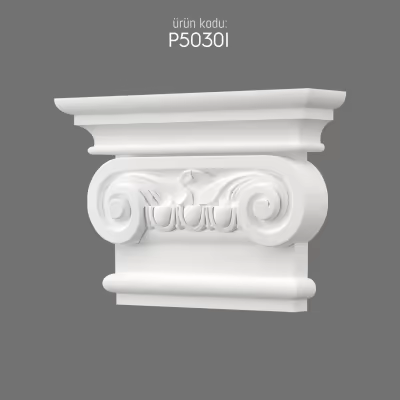
42x42x29 cm Polyurethane Pilaster Column Decoration
Technical Specifications
| Material | Polyurethane |
|---|---|
| Surface | Belirtilmemiş |
| Color | Belirtilmemiş; boyanabilir |
| Density | Belirtilmemiş |
| Water Absorption | below 1% |
| Service Temperature | -100 °C / +80 °C |
| Fire Class | B2 (flame retardant) |
| Paintable | Yes |
| Usage | Indoor + Outdoor |
| Water Resistant | Yes |
| Diameter | Ø 42 cm |
| Dimensions | 424 × 424 × 291 mm |
| Sales Unit | piece |
Details
Support
Similar Products(Pilaster Column Ionic Capital)


The P5030I Pilaster Column is a polyurethane architectural decoration element designed to complete the upper section of a pilaster composition in classical architecture. As part of the Ionic capital category, it creates a decorative transition between a flat wall surface and a column arrangement. Its 42x42x29 cm dimensions provide a clearly defined capital proportion for entrance surrounds, interior column designs and facade details.
Made from rigid polyurethane with a closed-cell structure, the product has a density of 150-220 kg/m³. Compared with plaster, concrete or solid wood alternatives, this construction allows for a lighter installation while helping preserve fine decorative lines. The temperature resistance of the P5030I is -100 °C / +80 °C. Water absorption is below 1%, and the product offers high dimensional stability. It is intended for decorative use and is not a structural load-bearing element.
The P5030I is a surface element suitable for classical column compositions featuring an Ionic capital form. Its capital function and square footprint should be considered without attributing motifs or ornamental details that are not visible in the product image. The paintable surface can be matched to the wall, facade or column finish specified in the architectural project. Water-based or synthetic paint may be used.
The P5030I Pilaster Column can be used to create a column effect integrated with the wall in entrance halls, living rooms, stair landings and high-ceilinged interiors. It can complete pilaster arrangements around windows or doors on villa and residential facades. In hotel lobbies, restaurant entrances and offices designed with classical lines, it adds emphasis to the capital area. For exterior applications, UV-resistant paint is required; the product should not be left unpainted.
Before installation, the surface must be clean, dry and sound. If cutting is required, use a 45° mitre cut. The P5030I is fixed to the surface with polyurethane (PU) mounting adhesive; silicone adhesive must not be used. Mechanical screw fixing is mandatory. Joints and screw heads are filled with filler, smoothed with 180-220 grit sandpaper, then finished with primer and two coats of paint. The factory primer prepares the surface for painting; additional primer is optional, but the paint manufacturer's warranty conditions should be checked separately.
The P5030I is a cuttable and repairable decorative element that reduces the handling and installation difficulties associated with heavy plaster pieces in classical pilaster designs. Its closed-cell PU structure provides advantages against moisture and decay. With correct surface preparation, mechanical fixing and a suitable paint system, it can be used for extended periods in interior and exterior architectural compositions.
- The P5030I Pilaster Column is used in classical column compositions featuring an Ionic capital arrangement
- In an entrance hall, it can complete the upper section between two pilasters and add architectural proportion around a doorway
- Applied to a wall in a living room or stair landing, it forms the capital section of a decorative, non-structural column appearance
- It can also be added to pilaster arrangements behind reception desks in hotel lobbies, restaurant entrances and classically designed offices
- On villa facades, it can complete pilaster applications around windows or doors
- The 42x42 cm square footprint should be planned together with the width of nearby mouldings and surfaces; its 29 cm height creates a distinct yet controlled transition in the capital area
- It is suitable for living rooms, bedrooms, hallways and high-ceilinged interior passage areas
- For exterior use, the surface must be protected with UV-resistant paint, and joints and screw points should be sealed with exterior-grade filler
- The piece is decorative and does not replace a structural column
- Make the installation surface clean, dry, sound and free of dust
- Measure and mark the position of the piece; if cutting is required, make a 45° mitre cut
- Apply polyurethane (PU) mounting adhesive to the rear surface of the P5030I and the suitable mounting surface
- Silicone adhesive must not be used
- After positioning the piece, mechanical screw fixing is mandatory; the connection method should be selected according to the product cross-section and the structure of the surface
- Fill screw heads and joint lines with filler
- Once dry, smooth the surface with 180-220 grit sandpaper
- The factory primer prepares the surface for painting; additional primer may be used according to the paint manufacturer's requirements
- Finish by applying two coats of paint
- Clean the P5030I surface with a soft, slightly damp cloth
- Abrasive chemicals, stiff brushes and impact-based cleaning can damage the decorative surface
- Indoors, inspect the painted surface regularly and remove accumulated dirt gently
- Outdoors, inspect the paint film, joints and screw points according to exposure conditions
- Unpainted polyurethane may yellow under UV exposure, so UV-resistant paint is required for exterior use
- If damage occurs, the area can be repaired with filler, 180-220 grit sandpaper and suitable paint
Can the P5030I Pilaster Column be used outdoors?
Yes, the product can be used for exterior architectural decoration. However, the pilaster column is not a structural element; it is installed as a decorative covering over an existing column or wall. It must not be left unpainted outdoors and should be protected with UV-resistant paint. Joints and screw points should be sealed with exterior-grade filler, and the installation surface must be checked to ensure that it is sound and dry. On facades exposed to heavy rainfall, sunlight and temperature changes, the selected paint system must be used according to the manufacturer's requirements.
How is a pilaster column installed and painted?
After the surface is cleaned and dried, position the piece and make a 45° mitre cut if necessary. Use polyurethane (PU) mounting adhesive for fixing; silicone must not be used. Mechanical screw fixing is mandatory. Fill the screw and joint areas, then smooth them with 180-220 grit sandpaper. The factory-primed surface is prepared for water-based or synthetic paint. Additional primer is not mandatory and should be selected according to the paint manufacturer's warranty conditions.
What are the density and temperature resistance of the P5030I?
The P5030I is a decorative piece made from closed-cell rigid polyurethane. Its density is 150-220 kg/m³. The stated temperature resistance is -100 °C / +80 °C. Water absorption is below 1%. These values explain the material's advantages against moisture and its dimensional stability; they do not mean that the piece can be used as a structural or load-bearing column.
What advantages does a polyurethane pilaster offer compared with plaster and wood?
A polyurethane pilaster offers a lighter decorative solution than plaster and is more tolerant of impact. Compared with wood, it provides advantages against moisture, decay and insect-related risks. Its closed-cell structure keeps water absorption below 1% and supports dimensional stability. The piece can be cut, filled, sanded and painted. However, it is not load-bearing; connection loads and the installation surface should be assessed according to the project before installation.
What dimensions and design is the P5030I intended for?
The P5030I measures 42x42x29 cm and is designed for pilaster column arrangements in the Ionic capital category. Its 42x42 cm square footprint should be planned together with the pilaster shaft or surrounding wall moulding. Its 29 cm height creates a distinct capital transition above a door, window, entrance hall or facade pilaster. Before installation, check its proportions in relation to the surrounding architectural elements and the load capacity of the surface.
Similar Products(Pilaster Column Ionic Capital)
The P5030I Pilaster Column is a polyurethane architectural decoration element designed to complete the upper section of a pilaster composition in classical architecture. As part of the Ionic capital category, it creates a decorative transition between a flat wall surface and a column arrangement. Its 42x42x29 cm dimensions provide a clearly defined capital proportion for entrance surrounds, interior column designs and facade details.
Made from rigid polyurethane with a closed-cell structure, the product has a density of 150-220 kg/m³. Compared with plaster, concrete or solid wood alternatives, this construction allows for a lighter installation while helping preserve fine decorative lines. The temperature resistance of the P5030I is -100 °C / +80 °C. Water absorption is below 1%, and the product offers high dimensional stability. It is intended for decorative use and is not a structural load-bearing element.
The P5030I is a surface element suitable for classical column compositions featuring an Ionic capital form. Its capital function and square footprint should be considered without attributing motifs or ornamental details that are not visible in the product image. The paintable surface can be matched to the wall, facade or column finish specified in the architectural project. Water-based or synthetic paint may be used.
The P5030I Pilaster Column can be used to create a column effect integrated with the wall in entrance halls, living rooms, stair landings and high-ceilinged interiors. It can complete pilaster arrangements around windows or doors on villa and residential facades. In hotel lobbies, restaurant entrances and offices designed with classical lines, it adds emphasis to the capital area. For exterior applications, UV-resistant paint is required; the product should not be left unpainted.
Before installation, the surface must be clean, dry and sound. If cutting is required, use a 45° mitre cut. The P5030I is fixed to the surface with polyurethane (PU) mounting adhesive; silicone adhesive must not be used. Mechanical screw fixing is mandatory. Joints and screw heads are filled with filler, smoothed with 180-220 grit sandpaper, then finished with primer and two coats of paint. The factory primer prepares the surface for painting; additional primer is optional, but the paint manufacturer's warranty conditions should be checked separately.
The P5030I is a cuttable and repairable decorative element that reduces the handling and installation difficulties associated with heavy plaster pieces in classical pilaster designs. Its closed-cell PU structure provides advantages against moisture and decay. With correct surface preparation, mechanical fixing and a suitable paint system, it can be used for extended periods in interior and exterior architectural compositions.
- The P5030I Pilaster Column is used in classical column compositions featuring an Ionic capital arrangement
- In an entrance hall, it can complete the upper section between two pilasters and add architectural proportion around a doorway
- Applied to a wall in a living room or stair landing, it forms the capital section of a decorative, non-structural column appearance
- It can also be added to pilaster arrangements behind reception desks in hotel lobbies, restaurant entrances and classically designed offices
- On villa facades, it can complete pilaster applications around windows or doors
- The 42x42 cm square footprint should be planned together with the width of nearby mouldings and surfaces; its 29 cm height creates a distinct yet controlled transition in the capital area
- It is suitable for living rooms, bedrooms, hallways and high-ceilinged interior passage areas
- For exterior use, the surface must be protected with UV-resistant paint, and joints and screw points should be sealed with exterior-grade filler
- The piece is decorative and does not replace a structural column
- Make the installation surface clean, dry, sound and free of dust
- Measure and mark the position of the piece; if cutting is required, make a 45° mitre cut
- Apply polyurethane (PU) mounting adhesive to the rear surface of the P5030I and the suitable mounting surface
- Silicone adhesive must not be used
- After positioning the piece, mechanical screw fixing is mandatory; the connection method should be selected according to the product cross-section and the structure of the surface
- Fill screw heads and joint lines with filler
- Once dry, smooth the surface with 180-220 grit sandpaper
- The factory primer prepares the surface for painting; additional primer may be used according to the paint manufacturer's requirements
- Finish by applying two coats of paint
- Clean the P5030I surface with a soft, slightly damp cloth
- Abrasive chemicals, stiff brushes and impact-based cleaning can damage the decorative surface
- Indoors, inspect the painted surface regularly and remove accumulated dirt gently
- Outdoors, inspect the paint film, joints and screw points according to exposure conditions
- Unpainted polyurethane may yellow under UV exposure, so UV-resistant paint is required for exterior use
- If damage occurs, the area can be repaired with filler, 180-220 grit sandpaper and suitable paint
Can the P5030I Pilaster Column be used outdoors?
Yes, the product can be used for exterior architectural decoration. However, the pilaster column is not a structural element; it is installed as a decorative covering over an existing column or wall. It must not be left unpainted outdoors and should be protected with UV-resistant paint. Joints and screw points should be sealed with exterior-grade filler, and the installation surface must be checked to ensure that it is sound and dry. On facades exposed to heavy rainfall, sunlight and temperature changes, the selected paint system must be used according to the manufacturer's requirements.
How is a pilaster column installed and painted?
After the surface is cleaned and dried, position the piece and make a 45° mitre cut if necessary. Use polyurethane (PU) mounting adhesive for fixing; silicone must not be used. Mechanical screw fixing is mandatory. Fill the screw and joint areas, then smooth them with 180-220 grit sandpaper. The factory-primed surface is prepared for water-based or synthetic paint. Additional primer is not mandatory and should be selected according to the paint manufacturer's warranty conditions.
What are the density and temperature resistance of the P5030I?
The P5030I is a decorative piece made from closed-cell rigid polyurethane. Its density is 150-220 kg/m³. The stated temperature resistance is -100 °C / +80 °C. Water absorption is below 1%. These values explain the material's advantages against moisture and its dimensional stability; they do not mean that the piece can be used as a structural or load-bearing column.
What advantages does a polyurethane pilaster offer compared with plaster and wood?
A polyurethane pilaster offers a lighter decorative solution than plaster and is more tolerant of impact. Compared with wood, it provides advantages against moisture, decay and insect-related risks. Its closed-cell structure keeps water absorption below 1% and supports dimensional stability. The piece can be cut, filled, sanded and painted. However, it is not load-bearing; connection loads and the installation surface should be assessed according to the project before installation.
What dimensions and design is the P5030I intended for?
The P5030I measures 42x42x29 cm and is designed for pilaster column arrangements in the Ionic capital category. Its 42x42 cm square footprint should be planned together with the pilaster shaft or surrounding wall moulding. Its 29 cm height creates a distinct capital transition above a door, window, entrance hall or facade pilaster. Before installation, check its proportions in relation to the surrounding architectural elements and the load capacity of the surface.