

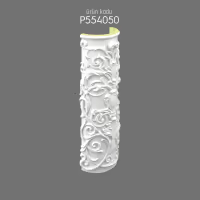
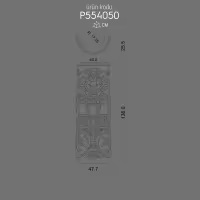
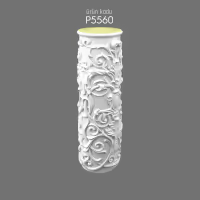
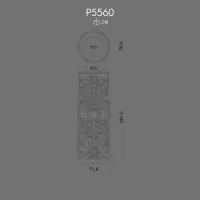
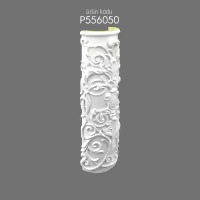
In classical architecture, vertical load-bearing systems require a strong visual foundation where they meet the ground. Historically crafted by hand-carving marble or stone blocks, these aesthetic pedestals are now reimagined through modern materials engineering. The Column elements in the Polure collection offer architects both lightweight handling and exceptional detail precision at floor transitions where vertical lines culminate. Thanks to a rigid polymer formula with a density of 150-200 kg/m³, they deliver a hardness comparable to wood while eliminating the fragile nature of traditional plaster and the high cost and structural load of marble.
Dimensional Variety and Scaling
Ceiling heights and spatial dimensions in architectural projects directly dictate the scale of the decorative bases required. The Polure product range offers alternatives scaled with millimeter precision to meet diverse spatial requirements:
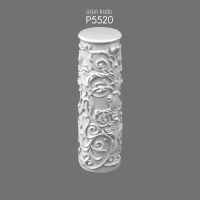
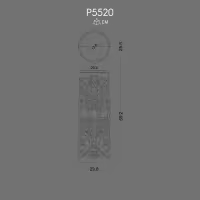
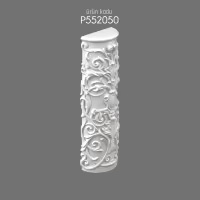
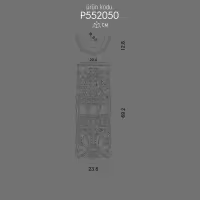
- P5520 and P552050 Models: Designed for narrower or minimalist transitions, the circular P5520 model measures 255x238x692 mm. For niche and facade applications requiring a flush fit against the wall, the half-section version P552050 (127x238x692 mm) is preferred.
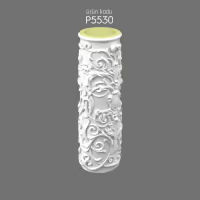
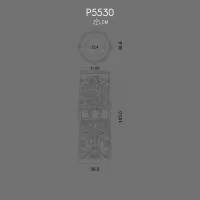
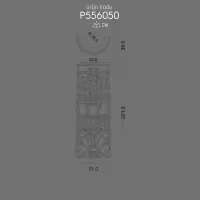
- P5530 and P553050 Models: Providing a balanced presence in medium-scale spaces, the P5530 model measures 386x360x1030 mm. Its half-round counterpart, the P553050 (193x360x1030 mm), integrates seamlessly with wall paneling.
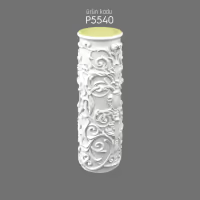
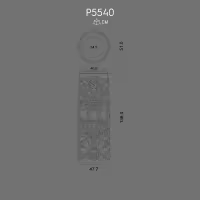
- P5540 and P5560 Monumental Series: Offering a grand presence in high-ceilinged hotel lobbies, villa entrances, or large-scale restoration projects, the P5540 (510x477x1360 mm) and the P5560 (760x710x2015 mm)—which stands as an independent work of art at over two meters tall—are monumental pedestals that add prestige to any project.
Advanced Material Characteristics
These specialized architectural elements are manufactured from rigid polyurethane (PU) raw material with a closed-cell structure. With a density ranging from 150 to 200 kg/m³ and a water absorption rate below 1%, this material resists rotting or swelling even in highly humid environments. Its high dimensional stability ensures it retains its shape through temperature fluctuations from -20°C to +80°C, preventing expansion, shrinkage, or warping under outdoor conditions. Its self-extinguishing property contributes to fire safety by ceasing to burn once the flame source is removed.
While its surface hardness enhances impact resistance, its factory-applied special primer allows for easy painting with water-based or synthetic paints. Acanthus leaves, floral carvings, and fluted details are flawlessly rendered on the surface, thanks to the precision of advanced mold-casting technology.
Usage Areas
Column designs offer a wide range of applications, providing a majestic finish indoors and a durable visual foundation on exterior facades. Indoors, they enrich vertical lines at the base of column systems supporting double-height ceilings in residential projects, hotel reception areas, ballrooms, and prestigious office lobbies. Half-round models function as decorative brackets or pedestals in wall panel transitions, fireplace surrounds, and vertical joints of library shelving systems. Outdoors, they are highly preferred in classical porticos, at the ground transitions of columns framing villa entrances, under-eave bracket systems, and in conservatory designs. Thanks to their water and moisture resistance, they also provide a long-lasting architectural solution for outdoor poolside decors and garden pavilions.
Installation
To achieve a long-lasting and flawless result during the installation of column elements, technical guidelines must be strictly followed. First, the application surface (floor and wall) must be dry, clean, and free of dust or loose particles. Cuts should be made precisely at a 45-degree miter angle. Silicone adhesives must never be used for bonding; instead, high-strength PU adhesives such as Polure Polfix should be preferred. Once the adhesive is applied, mechanical fastening with screws is mandatory to establish a secure physical bond with the surface. Especially for large-scale pedestals, screw fastening must not be neglected for safety reasons. After installation, joints and screw holes should be filled with high-quality exterior filler and smoothed with 180-220 grit sandpaper. Finally, a primer should be applied followed by two coats of paint. For exterior applications, UV-resistant exterior paint must be used to prevent the material from yellowing under sunlight.
Care Information
Thanks to their advanced polymer structure, maintaining column pedestals is highly practical. These elements, which do not rot like wood or crumble like plaster, can be easily cleaned with a damp, soft microfiber cloth. Dust accumulating in deep carvings and classical curves can be gently removed with a soft-bristled dry brush without damaging the surface. To protect the surface primer and paint, harsh chemicals containing solvents, acidic solutions, or abrasive wire sponges must never be used. pH-neutral, mild soapy water is the safest alternative. For exterior products, environmental dust accumulated over the years can be effortlessly washed away with low-pressure water and soft brushes to restore their original appearance.